Method of joints: a worked truss example, solved joint by joint
A seven-member truss, 8 m across, carries 12 kN at mid-span, and the method of joints finds every member force by balancing one pin at a time. Each equation is written out and each answer checked.
Method of joints on a 12 kN truss
A truss spans 8 m. The left support A is a pin at (0, 0), the right support C is a roller at (8, 0), and a middle bottom joint B at (4, 0) takes a 12 kN load straight down. Two top joints, D at (2, 3) and E at (6, 3), complete five joints and seven members: A-B, B-C, D-E, A-D, D-B, B-E and E-C. The count checks: 7 + 3 = 10 = 2 × 5, so the forces can be found by statics alone.
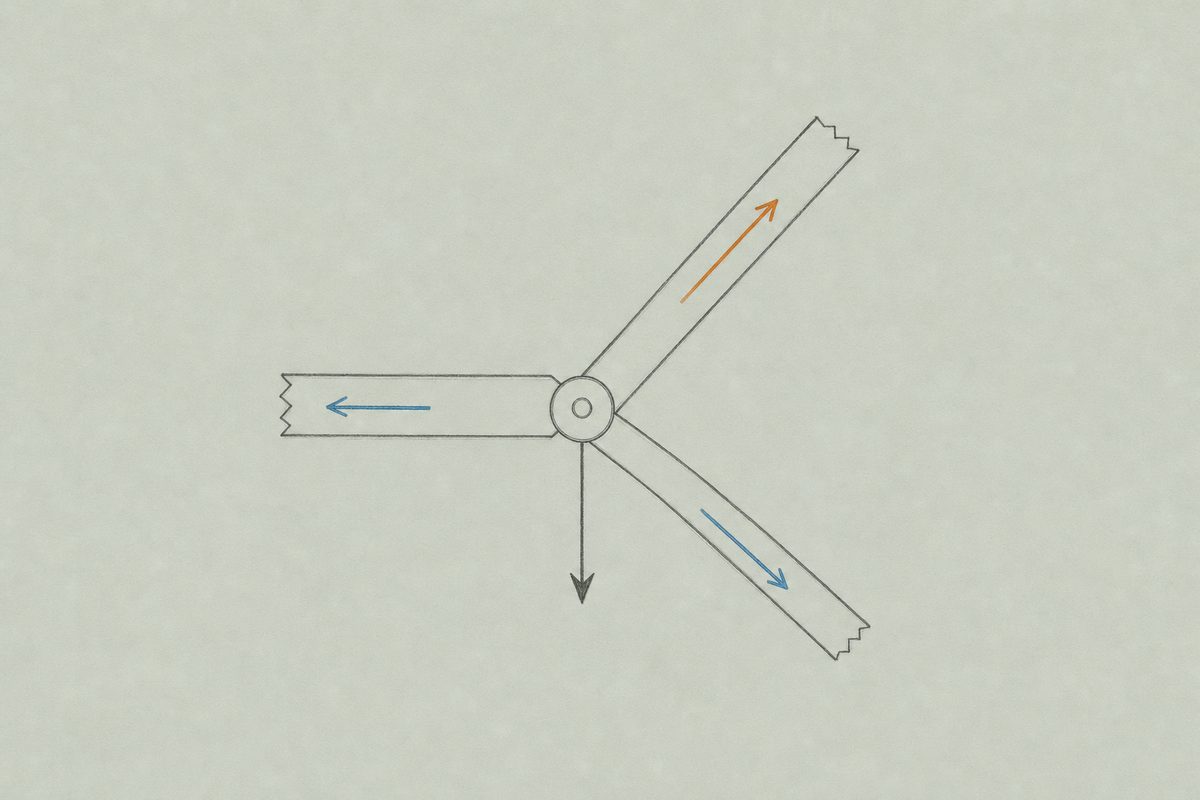
Every member is drawn as an arrow pulling away from its pin, a tension assumption, and each joint then gets its own pair of equations, ΣFx = 0 and ΣFy = 0. A negative answer later means the member is actually in compression.
First, the reactions. The load sits at mid-span, so the supports share it: A and C each take 6 kN upward. Moments about A confirm it, since C × 8 = 12 × 4 gives C = 6 kN, and the vertical balance 6 + 6 = 12 does the rest. There is no horizontal load, so A has no horizontal reaction.
Every inclined member here has the same geometry, 2 m across and 3 m up. Its length is √(2² + 3²) = √13 = 3.606 m, so its components are 2/3.606 = 0.5547 horizontally and 3/3.606 = 0.8321 vertically.
Joint A: two unknowns, so start here
Joint A has the 6 kN reaction pushing up and two members, A-B along the bottom and A-D rising to the right. Two unknowns, two equations.
ΣFy = 0: 6 + N_AD × 0.8321 = 0, so N_AD = −7.211 kN
ΣFx = 0: N_AB + N_AD × 0.5547 = 0, so N_AB = 7.211 × 0.5547 = +4.000 kN
A-D is in compression, because it must push the pin down to cancel the reaction pushing up, and A-B is in tension at 4.000 kN. The order matters: the vertical equation came first because only A-D appears in it.
Joint D: the next joint with two unknowns
D has A-D, already known, plus D-E and D-B. A-D is in compression, so it pushes on D along the line from A toward D with a force of 7.211 kN, which splits into 4.000 kN to the right and 6.000 kN upward. No load hangs at D. Take D-E horizontal and D-B falling to the right toward B.
ΣFy = 0: 6.000 − N_DB × 0.8321 = 0, so N_DB = +7.211 kN
ΣFx = 0: 4.000 + N_DB × 0.5547 + N_DE = 0, so N_DE = −8.000 kN
D-B is in tension and the top chord D-E is in compression at 8.000 kN. Everything so far matches the pattern from tension and compression: top chord pushed, bottom chord pulled.
Joint B: the load goes in here
At B the members are A-B (4.000 kN tension, pulling left), D-B (7.211 kN tension, pulling up and left), B-E and B-C, plus the 12 kN load downward. Unknowns: B-E and B-C. Two again, because D-B and A-B are already known.
ΣFy = 0: 7.211 × 0.8321 + N_BE × 0.8321 − 12 = 0, so N_BE = +7.211 kN
ΣFx = 0: −4.000 − 7.211 × 0.5547 + N_BE × 0.5547 + N_BC = 0, so N_BC = +4.000 kN
Both diagonals at B are in tension and share the 12 kN equally, 6 kN each as vertical components.
Joint C: nothing left to find, so it checks the work
Only E-C remains unsolved, and joint C has just two members, B-C and E-C. The vertical equation at C gives N_EC = −6 / 0.8321 = −7.211 kN. The horizontal equation then has to close on its own:
ΣFx at C: −4.000 + 7.211 × 0.5547 = −4.000 + 4.000 = 0
It does. The method of joints ends with a check rather than a new answer, and that zero is it. A slip anywhere along the way, a wrong sign or a swapped component, would have left a number there.
| Member | Force (kN) | Type |
|---|---|---|
| A-B | 4.000 | Tension |
| B-C | 4.000 | Tension |
| D-E | 8.000 | Compression |
| A-D | 7.211 | Compression |
| D-B | 7.211 | Tension |
| B-E | 7.211 | Tension |
| E-C | 7.211 | Compression |
Choosing the order, and spotting zero-force members
The method of joints only moves forward while a joint has two unknowns. Opening at B instead of A meets four unknowns (A-B, D-B, B-E, B-C) and cannot write enough equations. So the order is not a matter of taste: begin where the reaction is known and the members are few, then take whichever joint now has two unknowns. Here that was A, D, B, with C as the closing check. Once a joint shows three unknowns and no neighbour can help, the method of sections is the way out, and the same truss is solved with it on the next page.
A faster trick is worth knowing before the first joint. At a joint with no external load where exactly two members meet and they do not lie on one line, both members carry zero force: neither has anything to balance the other’s sideways component. The same follows for a joint where two collinear members and a third member meet with no load. Marking those members first removes them from the problem and often makes the next joint solvable. The truss above has none, since every joint is loaded or has three or more members, but any truss with an unloaded two-member joint will.
For the full picture of what the signs mean and why the compression members are the heavy ones, the sheet on truss analysis puts the methods side by side.
Questions5
What is the method of joints?
The method of joints isolates one joint, draws every member force acting on it, and applies ΣFx = 0 and ΣFy = 0. Two equations solve two unknown member forces. The next step is the next joint that has only two unknowns left.
Where does the method of joints start?
Start at a joint with a known reaction and no more than two unknown members, usually a support. Find the reactions of the whole truss first from overall equilibrium, otherwise the support joint has too many unknowns.
What happens when a joint has three unknown members?
Skip it and solve another joint first. Each solved member removes an unknown from the joints at its ends. If every remaining joint has three unknowns, cut the truss with the method of sections to break the deadlock.
How can a zero-force member be spotted quickly?
At an unloaded joint where only two members meet and they are not in a straight line, both carry zero force. The same holds for a third member that meets two collinear ones with no load at that joint.
Does the method of joints work for a computer-drawn truss?
Yes, and it makes a good check. Draw the same truss in the truss bridge designer and compare its member forces with the hand values. They should agree to the printed precision.
Next sheets4
- Method of sections the same truss solved with one cut
- Tension and compression what the signs mean for each member
- Truss analysis the idealisation and the determinacy count
- Factor of safety from member forces to a margin