Popsicle stick bridge: how to design, build and test a truss
A popsicle stick bridge almost never fails because the wood is weak. It fails at a glued joint or in a top chord that bows sideways, so this guide goes in the order that prevents both: layout, drawing, gluing, bracing, testing and a second try.
Choose a layout for your popsicle stick bridge
A standard craft stick is about 114 mm long, 10 mm wide and 2 mm thick, and that length is the first design constraint. The reference Warren is 12 m long and 3 m high, four panels, and its height equals one panel width. Scale it to a 300 mm span: each panel is 75 mm, the height is 75 mm, the chords are 75 mm and each diagonal is the square root of 37.5² + 75², about 84 mm (the diagonal is 1.118 times the chord). A 114 mm stick then leaves 39 mm spare on a chord and 30 mm on a diagonal for the overlap at a joint. A 400 mm span pushes the chords to 100 mm and the diagonals to about 112 mm, which leaves almost nothing, so a longer span means splicing two sticks with an overlap.
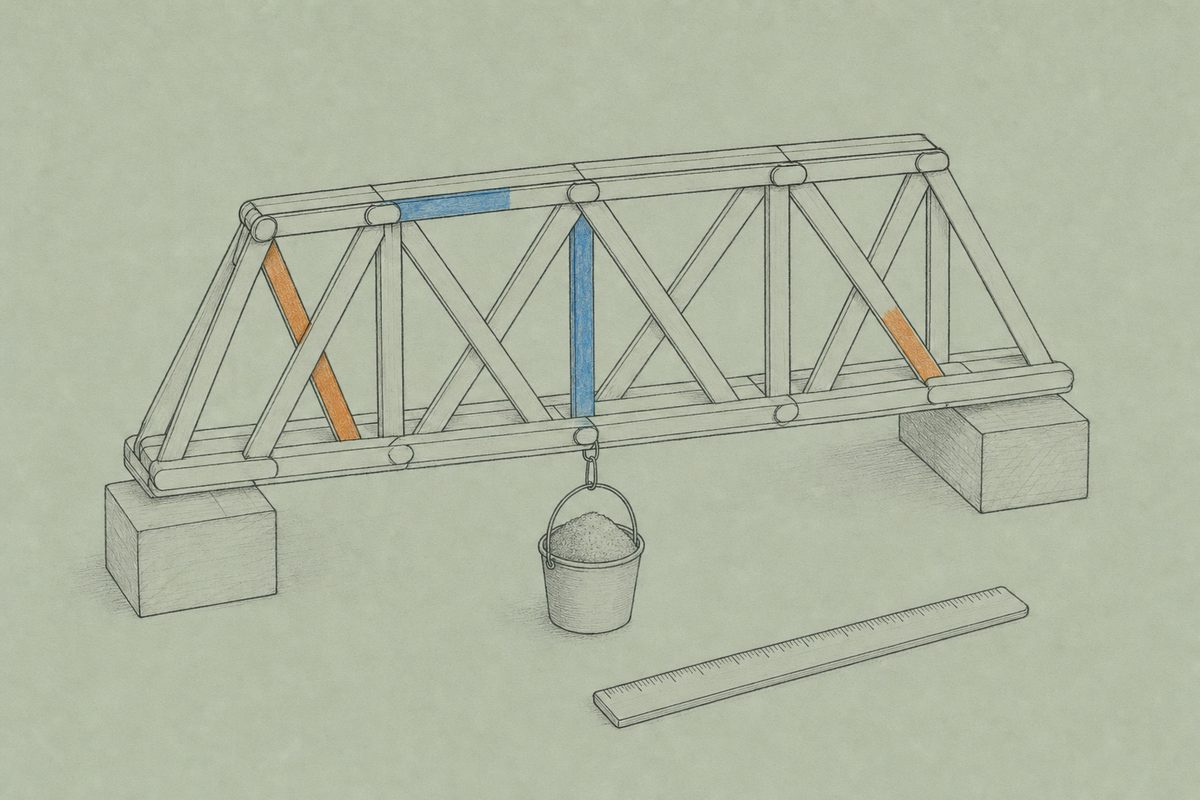
A four-panel Warren has 7 chord members (4 along the bottom, 3 along the top) and 8 diagonals, 15 members in all, few enough to glue in an evening. A popsicle stick bridge is best started as a Warren truss bridge for that reason, and because the force in each member is easy to read. The Pratt truss bridge is the alternative: its diagonals pull rather than push, which suits glued overlaps less well than it suits wood, and it needs more members and more joints.
Draw it full size, cut and lay out the members
Tape a sheet of paper to a flat board and draw the whole side of the truss at full scale, joint centres marked. Cover the drawing with baking paper or cling film so that glue does not stick the bridge to the plan. Lay each stick over its line, mark it and cut it to length; cut the sticks of one kind together against a stop so they match.
A hobby knife, a fine saw and a hot glue gun all cause injuries. Cutting is done on a cutting mat by an adult or under supervision, and hot glue is kept for jobs where a burn is unlikely.
Sort the sticks into labelled piles before gluing. A member that is 2 mm short is worse than one that is 2 mm long, because a short one leaves a gap that the glue has to bridge, and glue in a gap is the weakest joint there is.
Glue sequence: two side trusses, then cross-bracing
Build two identical side trusses flat on the drawing, then join them with cross-bracing. This is a standard approach, and it matters: a flat truss comes out straight, and the second one can be laid over the first to check that it matches.
Start with the bottom chord, then the top chord, then the diagonals, working from one end. Use a thin film of glue on both faces of an overlap, press, and weigh the joint down with a small block until it grips. Do not move a truss until it has cured. Glue manufacturers print a cure time on the label, and that time, not the builder’s patience, sets when the bridge may be loaded.
At each joint, add a gusset: a small piece cut from a stick glued over the meeting point of two or three members. It enlarges the bonded area, which is where bridges fail. Put gussets on both faces of the truss, and cut them to the same size so that the truss stays symmetrical.
When both side trusses have cured, stand them upright a bridge width apart, a width equal to the length of the cross-bracing sticks. Glue the cross-members between the matching top joints and between the bottom joints, check with a square that the trusses stand vertical, and add diagonal bracing in the plane of the top chord so that the pair cannot twist. Lay a deck of sticks across the bottom joints only if the rules require one; loading should be through the joints, as the idealised truss assumes.
Which members need doubling
The solver gives the following forces for the reference Warren, 20 kN at the centre bottom joint. At model scale the pattern is the same: the forces are fixed fractions of the hanging load.
| Member | Length, m | Force, kN | State | Share of largest force |
|---|---|---|---|---|
| G–H | 3.00 | 20.0 | Compression | |
| C–D | 3.00 | 15.0 | Tension | |
| B–C | 3.00 | 15.0 | Tension | |
| G–C | 3.35 | 11.2 | Tension | |
| D–I | 3.35 | 11.2 | Tension | |
| I–E | 3.35 | 11.2 | Compression | |
| C–H | 3.35 | 11.2 | Tension | |
| H–D | 3.35 | 11.2 | Compression | |
| A–F | 3.35 | 11.2 | Compression | |
| F–B | 3.35 | 11.2 | Tension | |
| B–G | 3.35 | 11.2 | Compression | |
| H–I | 3.00 | 10.0 | Compression | |
| F–G | 3.00 | 10.0 | Compression | |
| A–B | 3.00 | 5.0 | Tension | |
| D–E | 3.00 | 5.0 | Tension |
Reading it as a builder: the three top-chord members are in compression, F-G and H-I at 10 kN and G-H at 20 kN, and G-H carries exactly as much as hangs from the middle, so it is the one to double, with two sticks laminated face to face. The four diagonals running down toward the supports from the top joints, A-F, B-G, D-H and E-I, each carry 11.18 kN of compression and are the next candidates. The tension members, the centre bottom chord B-C and C-D at 15 kN, do not buckle, but they pull on a glued overlap, so give those joints extra gusset area instead of extra sticks. The end bottom members, at 5 kN, can stay single.
Test the popsicle stick bridge and read the failure
Hang a bucket from a loop of string at the centre of the bottom chord, with the bridge resting on two supports at a fixed span. A stick bridge fails suddenly and the bucket falls, so everyone wears eye protection, bystanders stand back, and a padded catch box sits under the bridge. Add weight a little at a time, such as sand scooped into the bucket or small identical weights, pausing after each step to watch the top chord. Write down the load at failure, weigh the bridge, and divide.
Three failures account for most stick bridges. A joint peels in tension, when the bottom-chord overlap pulls apart along the glue line. The top chord buckles in compression, bowing sideways or snapping in the middle once it is slender enough to bend. The deck, if there is one, bends between joints because a load sits on a span of unsupported stick.
Each has a repair. Peeled joints get a bigger gusset or a longer overlap, buckled chords get doubled and braced, and a deck gets closer supports.
The table below is for each test of a popsicle stick bridge, filled in with measurements from the bench.
| Test | Bridge mass (g) | Failure load (g) | Load divided by mass | First member to fail | Failure type | Change for next version |
|---|---|---|---|---|---|---|
| 1 | ||||||
| 2 | ||||||
| 3 |
Change one thing per version. Doubling the top chord and widening all the gussets in the same round hides which change moved the number. After each test, compare the load divided by mass, as described on the model bridge building sheet: a heavier bridge that carries only slightly more has not improved. The truss bridge designer is a cheap place to try the next change first, since it shows the same force pattern without spending a stick, and a second test of the same bridge after the glue on a new gusset has cured is a fair way to see what one gusset is worth.
Questions5
How strong is a popsicle stick bridge?
A four-panel Warren buckles at its centre top chord at 2.4 times the hanging load in the idealised model; a real bridge fails sooner, at a joint. Measure yours and record the number in the table on this page.
What is the best design for a popsicle stick bridge?
For a first bridge, a Warren truss: few members, all about the same length, and every joint is a simple meeting of two or three sticks. A Pratt truss is the next step once the first one has shown you where it fails.
What glue should I use for a popsicle stick bridge?
White PVA or wood glue is the usual choice because it soaks into the wood and can be applied in thin, even lines. Hot glue sets fast but leaves thick, brittle blobs. Follow the label for cure time and let the bridge cure fully before loading it.
Why does the top of my popsicle stick bridge bend sideways?
The top chord is in compression, and a long, thin stick under push buckles toward its weakest direction. Cross-bracing between the two side trusses holds the chord in line. Without bracing, the sideways buckle usually comes before any stick snaps.
How do I make a popsicle stick bridge hold more weight?
Strengthen the member that failed, not every member. Double the centre top chord, widen the overlap at the joint that peeled, and add cross-bracing. Then compare load divided by mass, so you know whether the added sticks paid for themselves.
Next sheets5
- Toothpick bridge the same ideas with round members and bundles
- Model bridge building materials, testing and the efficiency score
- Warren truss bridge forces in every member of the layout used here
- Truss bridge designer try a layout before you cut
- Classroom bridge design contest rules and scoring for a class test